
Real Estate Calculator
Estimate rental property cash flow, mortgage payment, net operating income, cap rate, cash-on-cash return, and 5-year investment projection.
Property & Loan Details
Enter property price, loan details, income, and expenses. Then click Calculate.
This calculator gives estimates only. Real estate returns depend on market conditions, financing, taxes, repairs, vacancy, rent changes, and selling costs.
Enter your details and click Calculate Real Estate Return.
Monthly Expense Breakdown
Mortgage$0.00
Taxes & Insurance$0.00
HOA / Maintenance$0.00
Vacancy / Management / Other$0.00
5-Year Investment Projection
| Estimated property value after 5 years | $0.00 |
| Estimated loan balance after 5 years | $0.00 |
| Estimated equity after 5 years | $0.00 |
| Estimated selling cost | $0.00 |
| Estimated net sale proceeds | $0.00 |
| Estimated total 5-year cash flow | $0.00 |
| Estimated total profit after 5 years | $0.00 |
| Estimated 5-year return on cash invested | 0% |
Real Estate Summary
| Monthly gross income | $0.00 |
| Monthly vacancy estimate | $0.00 |
| Monthly operating expenses | $0.00 |
| Annual cash flow | $0.00 |
| Debt service coverage ratio | 0 |
| Investment status | — |
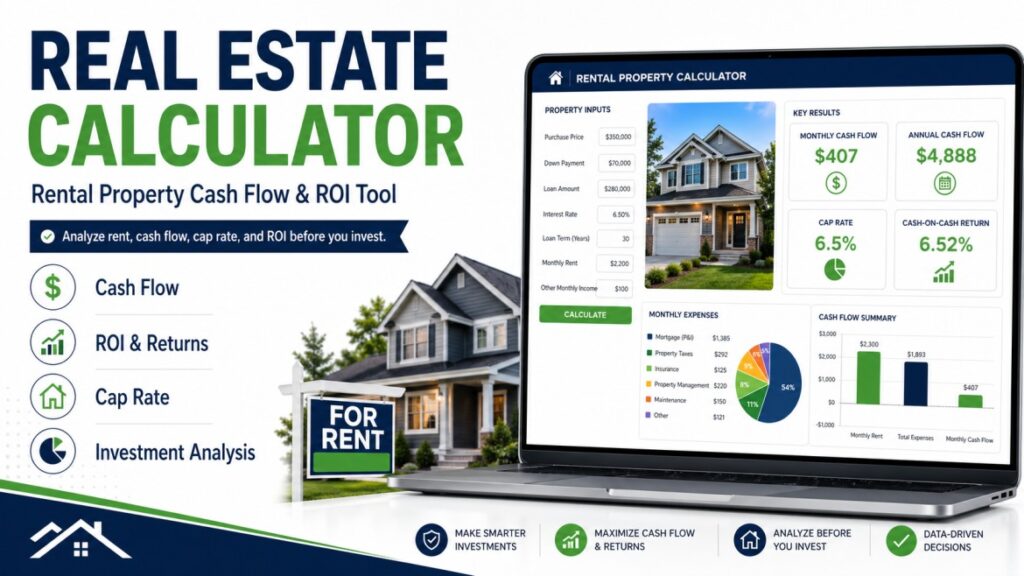
Real Estate Calculator: Rental Property Cash Flow and ROI Tool
A real estate calculator helps investors analyze whether a rental property is actually profitable before buying it. Instead of guessing if a deal is good, you can use a rental property calculator to estimate monthly cash flow, return on investment, cap rate, cash-on-cash return, mortgage payment, operating expenses, and long-term profit potential.
For U.S. real estate investors, a rental property may look attractive on the surface, but the true numbers matter. Rent income, mortgage payments, property taxes, insurance, repairs, vacancy, property management fees, HOA fees, and closing costs can all change your final return.
That is why a rental property cash flow and ROI calculator is one of the most useful tools for landlords, real estate investors, house hackers, and anyone comparing investment properties.
What Is a Real Estate Calculator?
A real estate calculator is an online tool that helps estimate the financial performance of a property. It uses key investment numbers such as purchase price, rental income, down payment, loan terms, taxes, insurance, and expenses to calculate whether the property may generate positive or negative cash flow.
A good real estate investment calculator can help answer questions like:
- Is this rental property a good investment?
- How much monthly cash flow can I expect?
- What is my rental property ROI?
- What is my cap rate?
- What is my cash-on-cash return?
- How much should I pay for a rental property?
- Will this property make money after expenses?
- How much rent do I need to break even?
- Should I buy this property or pass on the deal?
Why Real Estate Investors Need a Rental Property Calculator
Buying rental property without running the numbers is risky. A property can have strong rent income but still lose money after expenses and debt payments.
A rental property calculator helps investors understand the full financial picture before making an offer.
It can help you estimate:
- Monthly rental income
- Mortgage payment
- Operating expenses
- Net operating income
- Monthly cash flow
- Annual cash flow
- Cap rate
- Cash-on-cash return
- Total ROI
- Break-even rent
- Vacancy impact
- Repair and maintenance costs
- Long-term wealth potential
Cap rate is commonly used to estimate the rate of return on an income-producing property by dividing net operating income by property value. (Investopedia)
How a Real Estate Calculator Works
A real estate calculator starts with income, subtracts expenses, then calculates returns.
The basic process looks like this:
- Enter the property purchase price.
- Add your down payment and loan details.
- Enter expected monthly rent.
- Add operating expenses.
- Include vacancy and repair estimates.
- Calculate mortgage payment.
- Estimate monthly cash flow.
- Calculate ROI, cap rate, and cash-on-cash return.
The goal is to show whether the property creates positive cash flow and whether the return is worth the investment risk.
Key Inputs for a Real Estate Investment Calculator
To get accurate results, use realistic numbers. Do not only enter the best-case scenario.
| Calculator Input | Why It Matters |
|---|---|
| Purchase price | Determines loan size and investment basis |
| Down payment | Affects cash invested and loan amount |
| Closing costs | Increases your total upfront investment |
| Repair costs | Important for fixer-upper properties |
| Monthly rent | Main source of rental income |
| Vacancy rate | Accounts for empty months or unpaid rent |
| Property taxes | Major expense in many U.S. markets |
| Insurance | Protects the property and affects cash flow |
| HOA fees | Can reduce rental profit |
| Property management | Important if you hire a manager |
| Maintenance | Covers ongoing repairs |
| Capital expenditures | Covers major replacements like roof, HVAC, plumbing |
| Mortgage rate | Affects monthly loan payment |
| Loan term | Changes debt payment and cash flow |
| Appreciation estimate | Helps project long-term value |
| Selling costs | Important for exit strategy |
Main Results a Real Estate Calculator Should Show
A strong rental property calculator should not only show monthly profit. It should give a complete investment breakdown.
Monthly Cash Flow
Monthly cash flow is the money left after collecting rent and paying expenses, including the mortgage.
Basic formula:
Monthly Cash Flow = Monthly Rental Income − Monthly Expenses − Monthly Mortgage Payment
Example:
| Item | Monthly Amount |
|---|---|
| Rent income | $2,500 |
| Operating expenses | $800 |
| Mortgage payment | $1,300 |
| Monthly cash flow | $400 |
In this example, the property produces $400 per month in estimated cash flow.
Annual Cash Flow
Annual cash flow shows yearly profit before taxes.
Annual Cash Flow = Monthly Cash Flow × 12
Example:
$400 × 12 = $4,800 annual cash flow
This helps investors compare properties side by side.
Net Operating Income
Net operating income, or NOI, is rental income minus operating expenses before mortgage payments.
Formula:
NOI = Gross Rental Income − Vacancy Loss − Operating Expenses
NOI is important because it shows how the property performs before financing. The income approach in real estate valuation often uses net operating income and cap rate to estimate value. (Investopedia)
Example:
| Item | Annual Amount |
|---|---|
| Gross rent | $30,000 |
| Vacancy allowance | $1,500 |
| Operating expenses | $9,000 |
| NOI | $19,500 |
Cap Rate
Cap rate, or capitalization rate, estimates the return on a property if it were purchased without financing.
Formula:
Cap Rate = Net Operating Income ÷ Property Value × 100
Example:
| Item | Amount |
|---|---|
| NOI | $19,500 |
| Property price | $300,000 |
$19,500 ÷ $300,000 × 100 = 6.5% cap rate
Cap rate is useful for comparing rental properties in the same market, but it does not include mortgage financing.
Cash-on-Cash Return
Cash-on-cash return measures annual pre-tax cash flow compared with the actual cash you invested.
Formula:
Cash-on-Cash Return = Annual Pre-Tax Cash Flow ÷ Total Cash Invested × 100
Cash-on-cash return is especially useful for financed real estate deals because it focuses on return compared with the investor’s personal cash invested. (Investopedia)
Example:
| Item | Amount |
|---|---|
| Annual cash flow | $4,800 |
| Down payment | $60,000 |
| Closing costs | $6,000 |
| Repairs | $9,000 |
| Total cash invested | $75,000 |
$4,800 ÷ $75,000 × 100 = 6.4% cash-on-cash return
Rental Property ROI
Rental property ROI measures overall return compared with investment cost. ROI can be calculated in different ways depending on whether the property is purchased with cash or financing. Investopedia notes that real estate ROI can vary depending on financing, rental income, and costs involved. (Investopedia)
A simple ROI formula is:
ROI = Annual Return ÷ Total Investment × 100
A more advanced calculator may include:
- Annual cash flow
- Principal paydown
- Appreciation
- Tax benefits
- Selling costs
- Depreciation
- Capital gains
Example Real Estate Calculator Scenario
Here is a sample rental property analysis.
| Property Detail | Example |
|---|---|
| Purchase price | $300,000 |
| Down payment | 20% / $60,000 |
| Closing costs | $6,000 |
| Initial repairs | $9,000 |
| Total cash invested | $75,000 |
| Monthly rent | $2,500 |
| Vacancy estimate | 5% |
| Monthly operating expenses | $800 |
| Mortgage payment | $1,300 |
| Monthly cash flow | $400 |
| Annual cash flow | $4,800 |
| Estimated NOI | $19,500 |
| Cap rate | 6.5% |
| Cash-on-cash return | 6.4% |
This type of breakdown helps investors decide whether the property fits their goals.
What Expenses Should a Rental Property Calculator Include?
Many new investors make the mistake of only subtracting the mortgage payment from rent. That can make a weak deal look profitable.
A realistic calculator should include all major rental property expenses.
Property Taxes
Property taxes vary by state, county, and city. High-tax markets can significantly reduce cash flow.
Landlord Insurance
Rental property insurance is usually different from standard homeowners insurance. It can cost more depending on location, coverage, and property type.
Repairs and Maintenance
Every rental property needs repairs. Common costs include plumbing, appliances, paint, flooring, locks, landscaping, and general maintenance.
Vacancy
Vacancy accounts for lost rent when the property is empty or a tenant does not pay.
For example, a 5% vacancy allowance on $2,500 monthly rent equals:
$2,500 × 12 × 5% = $1,500 per year
Property Management
If you hire a property manager, they may charge a percentage of monthly rent. Many investors estimate around 8% to 10%, but fees vary by market and service.
HOA Fees
HOA fees can reduce profit and may increase over time. Always include them.
Capital Expenditures
Capital expenditures, also called CapEx, are major long-term replacement costs.
Examples include:
- Roof replacement
- HVAC system
- Water heater
- Major plumbing
- Electrical repairs
- Driveway replacement
- Appliance replacement
Utilities
If the landlord pays water, sewer, trash, gas, electricity, or lawn care, these must be included.
Licensing and Local Fees
Some U.S. cities require rental registration, inspections, short-term rental permits, or landlord licenses.
Rental Property Cash Flow Formula
The basic rental cash flow formula is:
Cash Flow = Rental Income − Operating Expenses − Debt Service
Example:
| Item | Monthly Amount |
|---|---|
| Monthly rent | $2,200 |
| Vacancy reserve | $110 |
| Taxes | $300 |
| Insurance | $125 |
| Repairs | $150 |
| Property management | $200 |
| HOA | $75 |
| Mortgage payment | $1,100 |
Calculation:
$2,200 − $110 − $300 − $125 − $150 − $200 − $75 − $1,100 = $140
Estimated monthly cash flow: $140
A property with positive cash flow may still require emergency reserves, but it is usually healthier than a deal that loses money every month.
What Is a Good ROI for Rental Property?
There is no single perfect ROI for every rental property. A “good” return depends on the market, risk level, financing, property condition, management effort, and investor goals.
Some investors prefer:
- Strong monthly cash flow
- Long-term appreciation
- Tax advantages
- Equity growth
- Low-maintenance properties
- Short-term rental income
- House hacking opportunities
A lower ROI in a stable, appreciating market may still interest some investors. A higher ROI in a risky market may not be worth it if vacancy, repairs, or tenant issues are high.
What Is a Good Cap Rate?
Cap rate depends heavily on location and property type.
In general:
| Cap Rate | Possible Meaning |
|---|---|
| 3%–5% | Often seen in expensive or high-demand markets |
| 5%–8% | Common target range for many rental investors |
| 8%–10%+ | Higher return potential, often with higher risk |
A high cap rate is not always better. It may signal a riskier neighborhood, older property, weak tenant demand, or higher maintenance costs.
What Is a Good Cash-on-Cash Return?
Many rental property investors look for cash-on-cash return because it measures return on actual cash invested.
A simple guide:
| Cash-on-Cash Return | Investor View |
|---|---|
| Under 4% | May be low unless appreciation is strong |
| 4%–8% | Moderate return |
| 8%–12% | Stronger return for many investors |
| 12%+ | Attractive, but verify risk carefully |
Cash-on-cash return should be reviewed with property condition, rent stability, neighborhood quality, and financing risk.
Rental Property Calculator for Different Investor Types
First-Time Real Estate Investors
New investors should use the calculator to avoid overpaying and underestimating expenses.
Focus on:
- Cash flow
- Vacancy
- Repairs
- Property management
- Emergency reserves
- Mortgage payment
- Break-even rent
House Hackers
House hacking means living in one unit or room while renting out the rest.
A calculator can help estimate:
- Owner-occupied mortgage payment
- Rent from roommates or units
- Net housing cost
- Long-term cash flow after moving out
Long-Term Rental Investors
Long-term landlords should focus on stable income, tenant demand, maintenance, and cash flow.
Important metrics include:
- Monthly cash flow
- Cap rate
- Cash-on-cash return
- Rent growth
- Expense ratio
Short-Term Rental Investors
Short-term rentals require deeper analysis because income can change by season.
Include:
- Cleaning fees
- Platform fees
- Furniture costs
- Local permits
- Occupancy rate
- Seasonal pricing
- Higher maintenance
- Guest supplies
BRRRR Investors
BRRRR stands for buy, rehab, rent, refinance, repeat.
A calculator for BRRRR investors should include:
- Purchase price
- Rehab cost
- After repair value
- Rent after rehab
- Refinance loan amount
- Cash left in deal
- Cash-on-cash return after refinance
Real Estate Calculator vs. Mortgage Calculator
A mortgage calculator only estimates loan payments.
A real estate calculator goes further by analyzing investment performance.
| Tool | Main Purpose |
|---|---|
| Mortgage calculator | Estimates monthly loan payment |
| Real estate calculator | Estimates cash flow, ROI, cap rate, and returns |
| Rent calculator | Estimates rent affordability |
| House affordability calculator | Estimates home buying budget |
| Cap rate calculator | Compares property income to value |
| Cash flow calculator | Estimates monthly rental profit |
Investors should use a real estate calculator because rental properties require more analysis than a primary home purchase.
Tax Considerations for Rental Property Investors
Rental property taxes can affect your final return. A calculator may estimate pre-tax cash flow, but your after-tax return can be different.
Common tax-related items include:
- Rental income
- Mortgage interest
- Property taxes
- Repairs
- Insurance
- Property management fees
- Depreciation
- Travel expenses
- Legal and professional fees
The IRS states that residential rental property under the General Depreciation System is depreciated over 27.5 years. (IRS)
Tax rules can be complex, so investors should speak with a qualified tax professional before relying on tax assumptions.
Common Mistakes When Analyzing Rental Property
Ignoring Vacancy
Even strong rental markets can have vacancy. Always include a vacancy allowance.
Underestimating Repairs
Older homes may need more repairs than expected. A property with low rent and high repairs can quickly become unprofitable.
Forgetting CapEx
A property may look profitable until a roof, HVAC system, or major appliance needs replacement.
Using Best-Case Rent
Use realistic market rent, not the highest possible rent you hope to get.
Ignoring Property Management
Even if you self-manage today, include property management in your analysis. This helps you understand whether the deal still works if you hire help later.
Not Checking Local Rules
Some cities have rental registration, inspection rules, rent control, eviction restrictions, or short-term rental limits.
Overlooking Financing Costs
Investment property mortgage rates and down payment requirements can be different from primary residence loans.
Best Features for a Real Estate Calculator Tool
For a USA-focused website, your calculator should be easy to use and detailed enough for investors.
Recommended Inputs
- Purchase price
- Down payment
- Loan amount
- Interest rate
- Loan term
- Closing costs
- Repair costs
- Monthly rent
- Other income
- Vacancy rate
- Property taxes
- Insurance
- HOA fees
- Property management fee
- Maintenance estimate
- CapEx reserve
- Utilities
- Appreciation rate
- Rent growth rate
- Selling cost estimate
Recommended Outputs
- Monthly mortgage payment
- Monthly cash flow
- Annual cash flow
- Net operating income
- Cap rate
- Cash-on-cash return
- Total cash invested
- Break-even rent
- Expense ratio
- Loan-to-value ratio
- Long-term ROI projection
- Year-by-year return estimate
Real Estate Calculator – Rental Property Cash Flow and ROI Tool
Debt-to-Income Ratio Calculator: Check Your DTI Before Applying for a Loan
Rent Calculator: How Much Rent Can You Afford?
House Affordability Calculator: How Much Home You Can Afford
FAQ
What is a real estate calculator?
A real estate calculator is a tool that estimates rental property cash flow, ROI, cap rate, cash-on-cash return, mortgage payment, expenses, and investment profitability.
How do you calculate rental property cash flow?
Rental property cash flow is calculated by subtracting operating expenses and mortgage payments from rental income.
What is a good ROI for rental property?
A good ROI depends on market, risk, financing, appreciation, and investor goals. Many investors compare ROI with cap rate, cash-on-cash return, and long-term growth potential.
What is cap rate in real estate?
Cap rate is net operating income divided by property value. It estimates the unleveraged return of an income-producing property.
What is cash-on-cash return?
Cash-on-cash return compares annual pre-tax cash flow with the total cash invested in the property.
Does a real estate calculator include mortgage payments?
A good rental property calculator should include mortgage payments, taxes, insurance, HOA fees, maintenance, vacancy, and property management costs.
What expenses should I include for rental property?
Include property taxes, insurance, repairs, maintenance, vacancy, property management, HOA fees, utilities, CapEx reserves, and mortgage payments.
Is positive cash flow always a good investment?
Positive cash flow is important, but investors should also consider property condition, tenant demand, neighborhood quality, appreciation, financing, and long-term expenses.
What is the 1% rule in real estate?
The 1% rule says monthly rent should be around 1% of the purchase price. It is only a quick screening rule, not a full investment analysis.
Can I use this calculator for Airbnb or short-term rentals?
Yes, but short-term rentals need extra inputs such as occupancy rate, cleaning fees, platform fees, furniture costs, local permits, and seasonal pricing.
Final Thoughts
A real estate calculator helps investors make smarter decisions by showing the real numbers behind a rental property. Instead of relying on guesswork, you can estimate cash flow, ROI, cap rate, cash-on-cash return, expenses, and long-term profitability.
For U.S. real estate investors, the best deals are not always the cheapest properties or the highest-rent properties. The best deals are the ones where the numbers work after mortgage payments, taxes, insurance, repairs, vacancy, and management costs.
Before buying any rental property, use a rental property cash flow and ROI calculator to compare deals, protect your money, and invest with confidence.
Hi! I kow thbis iis kknd oof offf topic butt I waas wwondering whichh log platform aree yyou usding
foor this website? I’m getting fed up off Wordpess becuse I’ve haad issues with hackers aand I’m looking att options forr
anotber platform. I wouyld be fantastic iff yoou coulld poiknt mee iin thee directiln off
a good platform. xnxx