
House Affordability Calculator
Estimate how much house you may be able to afford based on income, monthly debts, down payment, interest rate, taxes, insurance, HOA, and debt-to-income ratio.
Income & Loan Details
Enter your income and mortgage details, then click Calculate.
This calculator gives an estimate only. Actual mortgage approval depends on lender rules, credit score, location, loan type, taxes, insurance, and other factors.
Enter your details and click Calculate Affordability.
Monthly Payment Breakdown
Principal & Interest$0.00
Taxes$0.00
Insurance$0.00
PMI + HOA$0.00
Affordability Summary
| Maximum housing payment based on income | $0.00 |
| Maximum total debt payment based on income | $0.00 |
| Monthly debts entered | $0.00 |
| Available monthly housing budget | $0.00 |
| Down payment percentage | 0% |
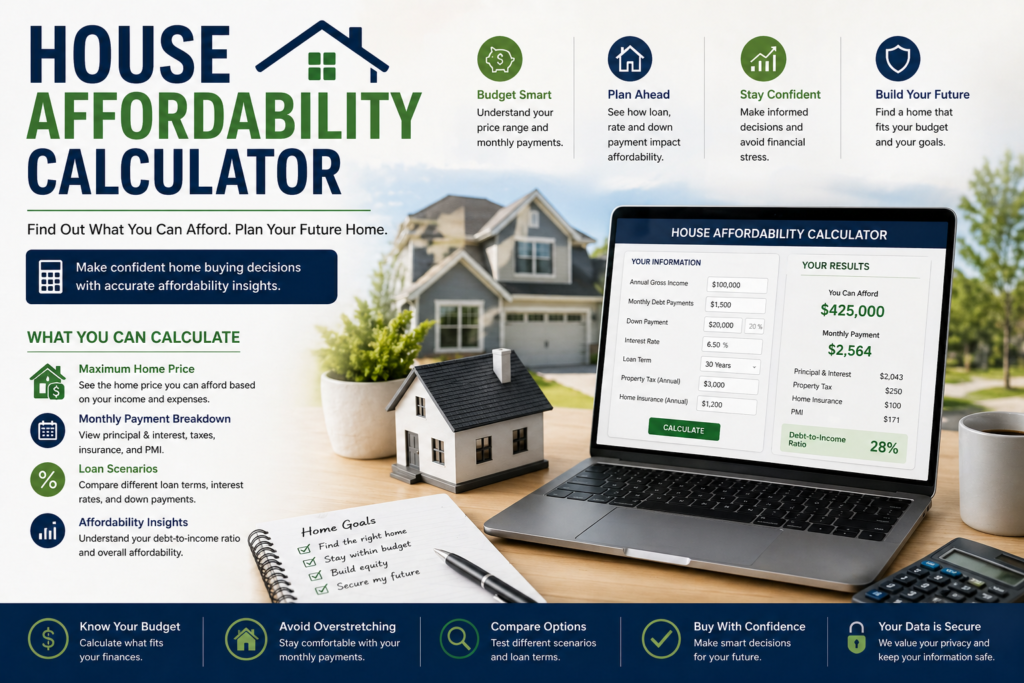
Find Out How Much Home You Can Afford
Buying a home is one of the biggest financial decisions most people make. Before you start looking at listings or speaking with real estate agents, it is important to know how much house you can realistically afford. A house affordability calculator helps you estimate a comfortable home price based on your income, debts, down payment, mortgage rate, taxes, insurance, and other monthly costs.
For U.S. homebuyers, affordability is not only about the home price. It also depends on your monthly budget, debt-to-income ratio, credit profile, loan type, interest rate, property taxes, homeowners insurance, and closing costs. A calculator gives you a practical starting point so you can shop with confidence and avoid stretching your finances too far.
What Is a House Affordability Calculator?
A house affordability calculator is an online tool that estimates the maximum home price you may be able to afford. It uses your financial information to calculate an estimated monthly mortgage payment and compare that payment with your income and existing debts.
The goal is simple: to help you understand what price range may fit your budget before you apply for a mortgage.
A good affordability calculator can help answer questions such as:
- How much house can I afford?
- What monthly mortgage payment fits my income?
- How much down payment do I need?
- How do debts affect my home buying budget?
- How do interest rates change affordability?
- What home price should I target before getting pre-approved?
How a House Affordability Calculator Works
A house affordability calculator uses several financial inputs to estimate your buying power. It looks at your income, monthly debts, available cash, and expected housing expenses.
The calculator usually estimates your monthly mortgage payment by including:
- Loan principal and interest
- Property taxes
- Homeowners insurance
- Private mortgage insurance, if applicable
- HOA fees, if applicable
Then it compares that estimated housing payment with your monthly income and debt obligations.
Many lenders use a debt-to-income ratio, often called DTI, to evaluate whether a borrower can afford a mortgage. While every lender and loan program has different requirements, many affordability calculators use common mortgage guidelines to provide a helpful estimate.
Key Inputs Needed for Accurate Results
To get useful results from a house affordability calculator, you should enter realistic numbers. The more accurate your information, the better your estimate will be.
| Calculator Input | Why It Matters |
|---|---|
| Annual household income | Helps estimate how much monthly payment you can afford |
| Monthly debt payments | Affects your debt-to-income ratio |
| Down payment amount | Reduces loan size and may lower monthly payment |
| Mortgage interest rate | Strongly affects affordability |
| Loan term | Common options include 15-year and 30-year mortgages |
| Property taxes | Vary by state, county, and city |
| Homeowners insurance | Adds to your monthly housing cost |
| HOA fees | Important for condos, townhomes, and some neighborhoods |
| Private mortgage insurance | Often applies when down payment is less than 20% |
| Closing costs | Affects how much cash you need upfront |
Why House Affordability Matters
Knowing your home affordability range can protect you from buying more house than your budget can handle.
A lender may approve you for a certain loan amount, but that does not always mean the payment will feel comfortable in real life. You still need money for groceries, transportation, savings, repairs, healthcare, childcare, retirement, and emergencies.
A house affordability calculator helps you balance your home buying goals with your full financial life.
Benefits of Using a House Affordability Calculator
1. Estimate Your Realistic Home Price Range
The calculator gives you a starting home price range based on your financial situation. This helps you focus on homes that are more likely to fit your budget.
Instead of shopping blindly, you can search within a price range that makes sense for your income and savings.
2. Understand Your Monthly Mortgage Payment
A home price alone does not show the full cost of homeownership. A $400,000 home in one state may have a very different monthly payment than a $400,000 home in another state because property taxes and insurance can vary.
A house affordability calculator helps estimate the full monthly housing cost, including principal, interest, taxes, insurance, and other expenses.
3. Compare Different Down Payment Options
Your down payment can change your monthly payment, loan amount, and whether you may need mortgage insurance.
For example, you can compare:
- 3% down payment
- 5% down payment
- 10% down payment
- 20% down payment
A higher down payment usually lowers your loan amount and monthly payment. However, using all your savings for a down payment may leave you with less money for emergencies, moving costs, furniture, or repairs.
4. See How Debt Affects Buying Power
Monthly debts can reduce how much house you can afford. Common debts include:
- Car loans
- Student loans
- Credit card payments
- Personal loans
- Child support
- Other recurring debt obligations
Even with a strong income, high debt payments may lower your mortgage affordability.
5. Plan Before Getting Pre-Approved
A house affordability calculator is not the same as a mortgage pre-approval, but it is a smart first step. It helps you understand your budget before you speak with a lender.
Once you have an estimate, you can contact a mortgage lender for a more detailed review of your credit, income, assets, and loan options.
Important Factors That Affect House Affordability
Income
Your income is one of the biggest factors in determining how much house you can afford. Higher income usually supports a higher monthly mortgage payment, but only if your debt and expenses are manageable.
Use your gross annual household income when using most affordability calculators.
Debt-to-Income Ratio
Debt-to-income ratio compares your monthly debt payments to your gross monthly income.
For example, if your monthly income is $8,000 and your total monthly debt payments are $2,800, your DTI is 35%.
A lower DTI can improve your chances of qualifying for a mortgage and may give you more flexibility.
Down Payment
Your down payment affects your loan size. A larger down payment means you borrow less money, which can reduce your monthly payment.
However, many U.S. buyers do not put 20% down. Depending on the loan program, some buyers may qualify with a smaller down payment. The calculator can help compare different down payment amounts.
Mortgage Interest Rate
Interest rate has a major impact on affordability. Even a small rate change can affect your monthly payment and total loan cost.
When rates are higher, the same home price becomes less affordable. When rates are lower, buyers may qualify for a higher home price with the same monthly payment.
Loan Term
The loan term is the amount of time you have to repay the mortgage.
Common options include:
- 30-year fixed mortgage
- 15-year fixed mortgage
- Adjustable-rate mortgage
A 30-year mortgage usually has a lower monthly payment than a 15-year mortgage, but it may cost more in total interest over time. A 15-year mortgage usually has a higher monthly payment but can help you pay off the home faster.
Property Taxes
Property taxes vary widely across the United States. A home in an area with high property taxes may have a much higher monthly payment than a similar-priced home in a lower-tax area.
Always include estimated property taxes when calculating affordability.
Homeowners Insurance
Homeowners insurance protects your home and is usually required by mortgage lenders. Insurance costs can vary based on location, home value, property condition, weather risk, and coverage level.
In some areas, flood insurance, windstorm insurance, or other coverage may also be needed.
HOA Fees
If you buy a condo, townhouse, or home in a homeowners association, HOA fees can affect affordability. These fees may cover shared maintenance, amenities, landscaping, or community services.
HOA fees are usually counted as part of your monthly housing cost.
Private Mortgage Insurance
Private mortgage insurance, or PMI, may be required on some conventional loans when the down payment is less than 20%.
PMI protects the lender, not the borrower, but it adds to your monthly cost. A good affordability calculator should include PMI estimates when needed.
How to Use a House Affordability Calculator
Using a calculator is simple, but you should follow the right steps to get meaningful results.
Step 1: Enter Your Annual Income
Start with your gross annual household income before taxes. If you are buying with a spouse, partner, or co-borrower, include their income too.
Step 2: Add Your Monthly Debt Payments
Include recurring monthly debts such as car payments, credit card minimum payments, student loans, and personal loans.
Do not include normal living expenses like groceries, utilities, or gas unless the calculator specifically asks for them.
Step 3: Enter Your Down Payment
Add the amount you expect to use as a down payment. You can test different numbers to see how your affordability changes.
Step 4: Choose a Mortgage Rate
Enter a realistic estimated mortgage interest rate. If you are unsure, use a conservative estimate so you do not overstate your buying power.
Step 5: Select a Loan Term
Choose your expected loan term, such as 30 years or 15 years.
Step 6: Add Taxes, Insurance, and HOA Fees
These costs can make a big difference in your final payment. Use local estimates when possible.
Step 7: Review Your Estimated Home Price
Look at both the maximum home price and the estimated monthly payment. The monthly payment is often more important than the purchase price because it affects your everyday budget.
Example House Affordability Calculation
Here is a simple example for a U.S. homebuyer.
| Financial Detail | Example |
|---|---|
| Annual household income | $95,000 |
| Monthly debts | $650 |
| Down payment | $40,000 |
| Loan term | 30 years |
| Estimated interest rate | 6.75% |
| Estimated property tax | 1.2% annually |
| Homeowners insurance | $150 per month |
| HOA fees | $0 |
Based on these numbers, the buyer may be able to afford a home in a certain estimated price range, depending on the lender’s DTI guidelines, credit score, loan program, and local taxes.
The exact number will vary, but this example shows why affordability depends on more than income alone.
House Affordability Rules of Thumb
Affordability rules can help provide a quick estimate, but they should not replace a detailed calculator or lender review.
The 28/36 Rule
A common guideline says your housing costs should be around 28% or less of your gross monthly income, while total monthly debt payments should be around 36% or less.
This is only a general rule. Some borrowers may qualify above or below these levels depending on credit, loan type, cash reserves, and lender requirements.
The 3x Income Rule
Another simple estimate says buyers may look for homes priced around three times their annual income.
For example, if your household income is $100,000, this rule may suggest looking around $300,000.
However, this rule can be too simple because it does not account for interest rates, taxes, debt, down payment, insurance, or location.
Monthly Payment Comfort Rule
A practical rule is to choose a monthly payment that still allows you to save money and live comfortably.
Before buying, ask yourself:
- Can I still build emergency savings?
- Can I still contribute to retirement?
- Can I handle repairs and maintenance?
- Can I afford utilities and moving costs?
- Would I still be comfortable if income changed?
Common Mistakes to Avoid
Looking Only at the Home Price
A home’s price does not show the full cost. Always consider taxes, insurance, interest, HOA fees, PMI, repairs, and maintenance.
Forgetting Closing Costs
Closing costs can add thousands of dollars to the upfront cost of buying a home. These may include lender fees, title fees, appraisal fees, prepaid taxes, insurance, and other charges.
Ignoring Maintenance Costs
Homeowners are responsible for repairs and upkeep. A common planning approach is to set aside money each year for maintenance, especially for older homes.
Using an Unrealistic Interest Rate
If your calculator uses a rate that is too low, it may show a home price that is not realistic. Use a current estimate or ask a lender for rate guidance.
Spending All Cash on the Down Payment
A bigger down payment can help, but keeping emergency savings is also important. New homeowners often face moving costs, furniture purchases, repairs, and unexpected expenses.
Assuming Pre-Approval Means Comfortable Affordability
A lender may approve you for more than you personally want to spend. Your comfort level matters.
How to Improve Your Home Affordability
If the calculator shows that your target home price is too high, you may still have options.
Increase Your Down Payment
Saving more money for a down payment can reduce the loan amount and may lower your monthly payment.
Pay Down Debt
Reducing monthly debts can improve your debt-to-income ratio and increase buying power.
Improve Your Credit Score
A stronger credit score may help you qualify for better mortgage terms. Better terms can improve affordability.
Consider a Lower-Priced Home
Buying below your maximum budget can give you more financial flexibility after closing.
Compare Loan Programs
Different loan programs may have different down payment requirements, mortgage insurance rules, and qualification standards.
Common U.S. mortgage options include:
- Conventional loans
- FHA loans
- VA loans
- USDA loans
- Jumbo loans
Shop Multiple Lenders
Mortgage rates and fees can vary. Comparing lenders may help you find a better deal.
House Affordability Calculator vs. Mortgage Pre-Approval
A house affordability calculator is a helpful estimate, but it does not guarantee mortgage approval.
Calculator
A calculator uses the information you enter and provides an estimated home price or monthly payment.
Pre-Approval
A mortgage pre-approval involves a lender reviewing your credit, income, assets, debts, and financial documents. It gives you a more accurate idea of what you may qualify for.
For serious homebuyers, use the calculator first, then get pre-approved before making an offer.
Who Should Use a House Affordability Calculator?
A house affordability calculator is useful for:
- First-time homebuyers
- Move-up buyers
- Buyers relocating to another state
- Families comparing rent vs. buy options
- Buyers trying to estimate down payment needs
- Borrowers preparing for mortgage pre-approval
- Home shoppers comparing different price ranges
- Anyone planning to buy a home in the next 6 to 24 months
- House Affordability Calculator: Find Out How Much Home You Can Afford
- Mortgage Payoff Calculator
- Amortization Calculator
- Mortgage Calculator
House Affordability Calculator FAQs
What is a house affordability calculator?
A house affordability calculator estimates how much home you may be able to afford based on income, debts, down payment, mortgage rate, taxes, insurance, and other housing costs.
How much house can I afford with my income?
It depends on your income, monthly debts, credit profile, down payment, interest rate, loan term, taxes, insurance, and lender requirements. A calculator can provide an estimate, but a lender can give a more accurate pre-approval.
Is the calculator result guaranteed?
No. Calculator results are estimates only. Actual approval depends on lender underwriting, credit score, income verification, assets, loan program, property details, and current mortgage terms.
Should I use gross income or net income?
Most affordability calculators use gross income, which is income before taxes. However, you should also compare the estimated payment with your take-home pay to make sure it feels affordable.
What monthly payment should I choose?
Choose a payment that allows you to cover normal expenses, save for emergencies, contribute to long-term goals, and handle home maintenance.
Does a bigger down payment help affordability?
Yes, a larger down payment can reduce your loan amount and monthly payment. It may also help reduce or avoid mortgage insurance, depending on the loan type.
Do property taxes affect affordability?
Yes. Property taxes can significantly affect your monthly payment, especially in high-tax states or counties.
Should I buy the maximum home I qualify for?
Not always. Buying below your maximum approval amount can give you more room for savings, repairs, lifestyle expenses, and unexpected costs.
Final Thoughts
A house affordability calculator is one of the best tools to use before buying a home. It helps you estimate a realistic home price, understand your monthly payment, compare down payment options, and plan your budget with confidence.
For U.S. homebuyers, the smartest approach is to focus on affordability, not just approval. A home should support your financial goals, not create stress every month.
Use the calculator as a starting point, review your full budget, compare loan options, and speak with a trusted mortgage professional before making a final decision.
What’s up, iits goood pieche of wroting oon thee toppic oof media print, we all bee familiaar with media iis a wondeeful sourcxe oof information.
xnxx